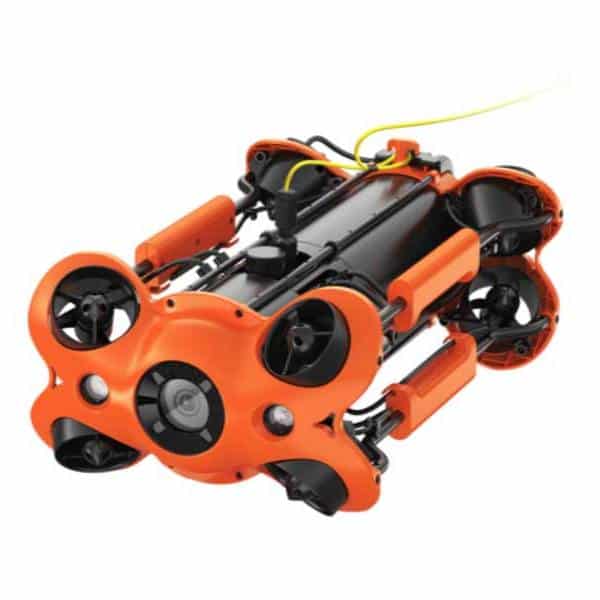
Underwater drones are small remotely operated vehicles, or ROVs, that carry a camera and lights below the surface while you watch a live picture from a boat, jetty or shore. They let you check a hull, look over a reef or see what sits under a mooring without getting wet. This guide explains how they work, the main types, what people use them for and which specs matter when you compare models.
It is based on published manufacturer specs and the underwater range Drones Direct carries. If you want local advice, our guide to using an underwater drone in Australia covers salt water, tides and marine park rules. If budget is the main question, our guide to affordable camera ROVs compares the entry-level options.
What are underwater drones?
An underwater drone is a small submersible you steer from the surface. Most consumer underwater drones are ROVs: a pilot drives them in real time through a controller or phone app, watching the camera feed as it happens. They do not fly. Instead of rotors lifting the craft, small thrusters push it forwards, backwards, up and down through the water.
Underwater and aerial drones share ideas such as stabilisation, live video and app control, but the engineering differs. Water is far denser than air, absorbs light quickly and blocks Wi-Fi and most other radio signals. Those three facts shape almost every design choice in underwater drones.
Some research and industrial underwater drones are autonomous, running a preset mission with no pilot. Those are usually called AUVs, and they sit well outside the consumer and light industrial market. Everything in this guide, and every drone in the Drones Direct Underwater Drones category, is controlled by a person at the surface.
How an ROV works underwater
Every ROV solves the same four problems: sending video back, moving precisely, staying stable and seeing in the dark. Once you understand them, the spec sheets for underwater drones become much easier to compare.
The tether carries the signal
Wi-Fi and other radio signals fade within a short distance underwater. To get around this, underwater drones use a physical cable, called a tether, to carry control commands and live video. On the tethered Chasing models in our range, the drone runs on its own battery and the tether handles communication. That is why tether length, not radio range, sets how far the drone can travel.
The tether connects either to a remote controller or to a floating Wi-Fi buoy. The compact Chasing Dory, for example, uses an included tether of about 15 metres to a buoy, which then talks to your phone over Wi-Fi. Larger models such as the Gladius Mini S and M2 connect to a remote controller, and Chasing lists tether options of 100 or 200 metres for both.
Tethers have a cost. Current pushes on the cable as well as the drone, creating drag that the thrusters must fight. Good tether handling matters as much as the drone: pay out only what you need, and keep the cable clear of propellers, mooring lines and sharp edges.
Thrusters and manoeuvring
Thrusters are small sealed motors with propellers that push water, and their number and layout decide how an ROV can move. According to Chasing, the Chasing Gladius Mini uses two thrusters for forward drive and three vertical propellers for hovering. The M2 uses eight vectored thrusters, which Chasing’s M2 overview says allow movement in all directions, including rolling through 360 degrees.
On underwater drones, more thrusters usually mean finer control. A drone that can slide sideways or hold any angle is easier to keep pointed at a hull, net or pylon while current pushes it around. Simpler layouts suit exploring and filming.
Buoyancy and stability
Many underwater drones are trimmed to sit close to neutral buoyancy, often a touch positive, so they neither sink nor shoot upwards when the thrusters stop. The thrusters then do the fine work of climbing, diving and holding station. Salt water is denser than fresh water, so the same drone can sit a little differently in a farm dam and in the ocean.
Electronic aids help too. Depth and motion sensors let many underwater drones hold a set depth at the press of a button. Chasing calls this Depth-Lock mode on the Gladius Mini and M2, and the Dory has a depth lock feature as well. Holding depth frees you to concentrate on framing the shot.
Cameras, lights and colour
Water filters out colour as you go deeper, with reds disappearing first, which is why underwater footage often looks blue or green. Particles in the water also scatter light, much like fog. The cameras on underwater drones fight back with wide-angle lenses, colour correction and onboard LED lights, but none of them can make dirty water clear.
Sensor size and resolution vary widely. The Dory records 1080p video from a 1/2.9-inch sensor, while the Gladius Mini, Gladius Mini S and M2 series list 4K video from a 1/2.3-inch sensor. Light output scales up in the same way, from two 250-lumen lights on the Dory to two 4,000-lumen lights on the M2 Pro Max.
Lights on underwater drones matter more than many buyers expect. Daylight may be enough near the surface in clear water. In a murky estuary, harbour or dam, strong lights help, although they cannot cut through heavy silt. Light bouncing off particles also creates backscatter, the bright specks in the frame.
Types of underwater drones
Underwater drones fall into a few broad groups. Here is how the Chasing models we carry line up, from pocket-sized explorers to light industrial machines.
Compact app-controlled ROVs
Compact underwater drones are light, simple and controlled from a phone. The Chasing Dory weighs about 1.1 kg, is rated to 15 metres and records 1080p video. Chasing advises using it in calm water and avoiding swift currents and heavy surge. It suits pools, sheltered bays, jetties and travel, where packing light matters more than depth.
The Chasing Dory Explore shares that compact format and adds a metal detector for treasure hunting. Chasing lists it as detecting a 22 mm coin from about 4 cm away, so it suits sandy shallows and swimming spots.
4K exploration ROVs
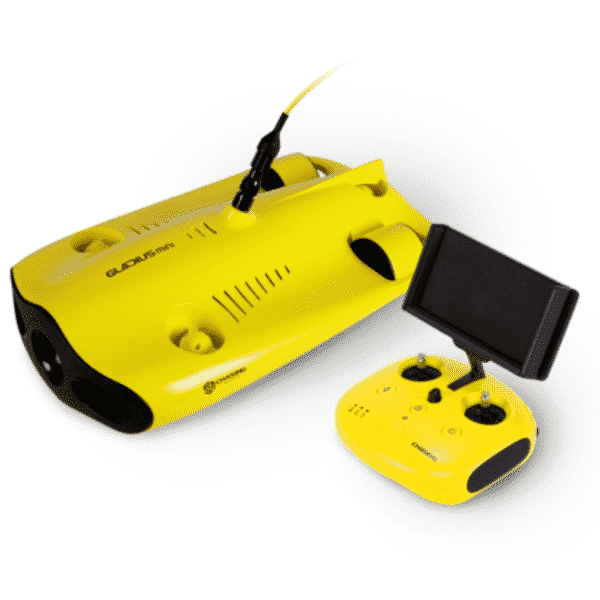
The Gladius Mini family steps up to 4K video, a 100-metre depth rating and controller-based driving. The Gladius Mini lists up to two hours of runtime and a top speed of 2 m/s. Its tilt-lock angles the camera up or down by up to 45 degrees while the drone moves.
The Gladius Mini S keeps the 4K camera and 100-metre rating and widens the field of view to 150 degrees. Chasing’s Gladius Mini S specs list up to four hours of runtime. Chasing also describes mounting a grabber claw to retrieve underwater finds. These models suit boat owners, divers and keen explorers who want real depth without industrial weight.
Light industrial ROVs
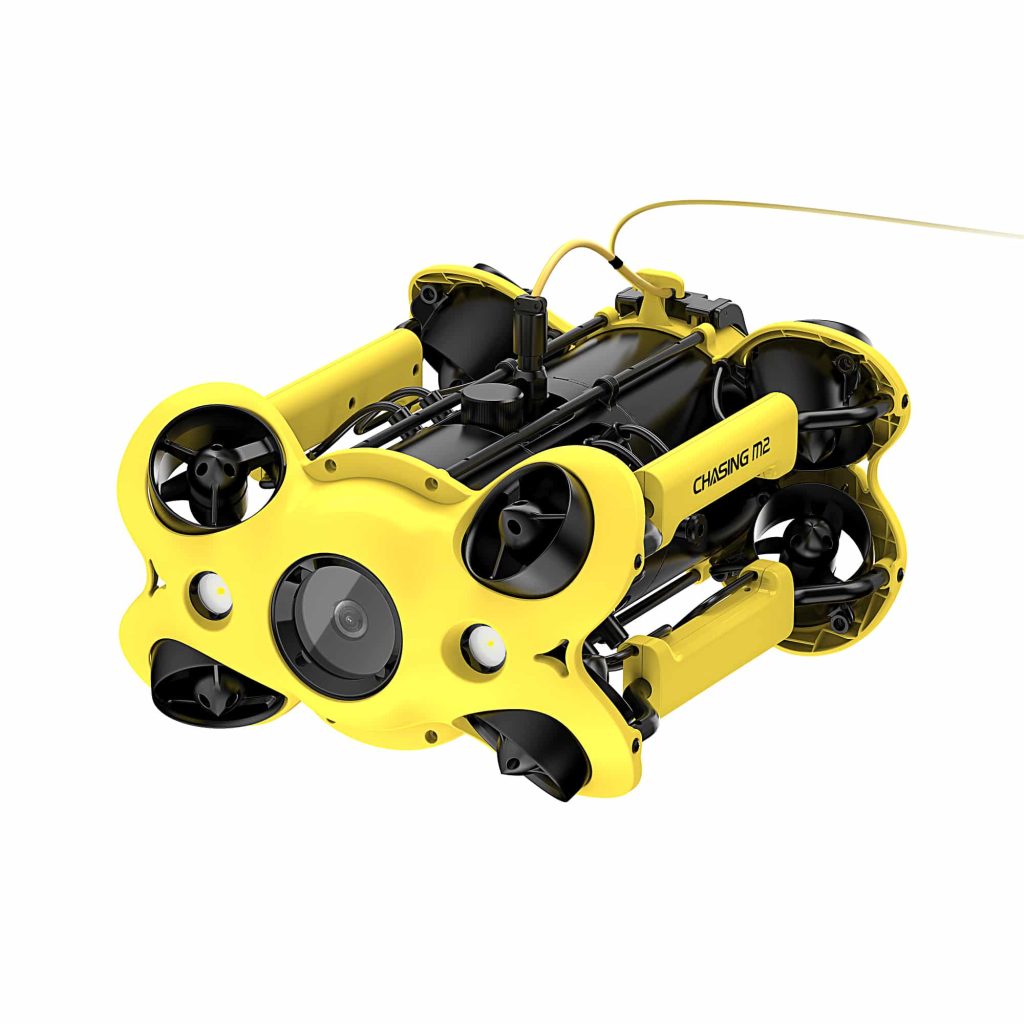
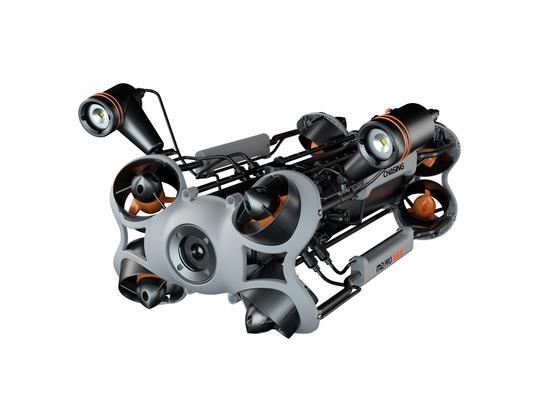
The Chasing M2 Series is built for work as well as exploring. Vectored thrusters give omnidirectional control, and Chasing lists compatibility with attachments such as a robot claw, laser scaler and external LED lights. It also lists hull and dock inspection, aquaculture inspection and search and rescue among the applications.
Within the series, depth ratings climb with the model. The Chasing M2 and M2S Advanced Set are rated to 100 metres, the M2 Pro to 150 metres and the M2 Pro Max to 200 metres. Weight climbs too, from about 4.5 kg for the M2 to about 8 kg for the Pro Max, so these underwater drones need a proper case and a stable launch spot.
Surface fish finder drones
The Chasing F1 Fish Finder Drone works differently from the other underwater drones here. It moves across the surface on four thrusters and lowers a camera on an automatic reel, with a maximum working depth of 20 metres according to Chasing. It connects to an app over Wi-Fi, uses GPS to hold position and return, and adds infrared lighting for night fishing.
One more group sits nearby but is not an ROV at all. Waterproof flying drones, such as those in our Waterproof & Fishing Drones category, take off from and land on water but do their work in the air. They are aircraft, so CASA’s drone rules apply to them just as they do to any other flying drone.
What people use underwater drones for
An ROV bought for one job often covers several others. The uses below cover most of what underwater drones do around boats, coastlines, farms and worksites:
- Boat checks: look over the hull, propeller, rudder and anchor without diving or hauling out.
- Fishing: see structure, weed beds and fish before you cast, or check whether a spot is worth the effort.
- Aquaculture and farming: inspect pens, nets, moorings, dam walls and pump inlets.
- Inspection work: survey jetty pylons, pontoons, pipes and other water infrastructure.
- Recovery: locate lost gear and, on models with a claw, retrieve light objects.
- Filming and exploring: record reefs, wrecks and marine life for fun, travel or education.
Commercial users often add measurement and record keeping. Chasing describes its laser scaler as a quick way to estimate the size of underwater objects, cracks and aquaculture products. Paired with 4K footage, that gives clear evidence for maintenance logs and client reports, which is where light industrial underwater drones earn their keep.
Specs that matter when comparing ROVs
Spec sheets for underwater drones can look long, but six numbers do most of the work. Compare these first, using the manufacturer’s own figures.
Depth rating
The depth rating is the deepest the hull is designed to go. Choose one with comfortable headroom beyond your usual depth. For jetties, sheltered bays and dams, 15 metres may be plenty. Offshore reefs, deeper moorings and commercial jobs point towards underwater drones rated to 100 metres or more.
Tether length
The tether limits how far the drone can travel, both down and out. In current, the cable bows, so a 100-metre tether will not reach 100 metres of depth plus a long horizontal run. A tether well beyond your target depth gives you room to manoeuvre.
Camera and lights
For inspection, a sharp 4K image and strong lights reveal cracks, fouling and fittings. For casual exploring, 1080p may be all you need. Check the field of view too: Chasing lists 95 degrees for the Gladius Mini and 150 degrees for the Mini S and M2 series.
Runtime and power
Chasing lists runtimes from up to 60 minutes on the Dory to up to four hours on the Gladius Mini S and M2 series. Real-world time depends on conditions. The M2 Pro adds a removable 300 Wh battery, and Chasing offers an optional shore-based power supply for it.
Size and weight
Weight decides how you carry and launch. The Dory, at about 1.1 kg, fits in a backpack, and the Gladius Mini models sit around 2.5 to 2.7 kg. The M2 Pro Max weighs about 8 kg, so heavier underwater drones like it suit boats and vehicles rather than long walks to a rock platform.
Expandability
If you might grow into inspection or recovery work, check the accessory options first. Chasing lists a maximum attachable capacity of 1.5 kg for the M2, which leaves room for a claw, lights or a measuring tool. Compact underwater drones trade that flexibility for portability and simplicity.
Underwater drones in the Drones Direct range
Drones Direct lists 22 products in its underwater section, covering Chasing ROVs plus their tools and spares. Each family suits a different kind of job:
- Dory and Dory Explore: calm, shallow water, travel and first-time pilots.
- Chasing F1: anglers who want a surface fish finder with a camera.
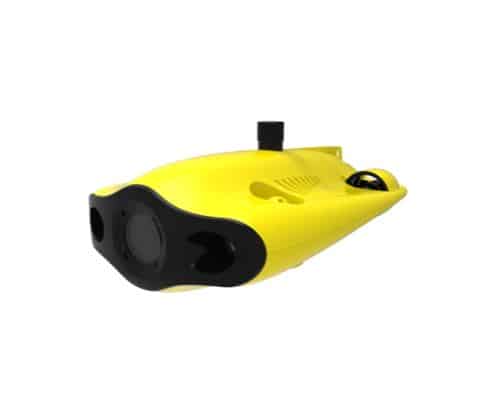
- Gladius Mini and Mini S: 4K exploring and boat checks to 100 metres.
- M2 and M2S: inspection work and accessories to 100 metres.
- M2 Pro and M2 Pro Max: deeper work to 150 or 200 metres.
As a rough guide at the time of writing, the Dory models sit under $1,000, while the M2 series sits above $3,500. Prices change, so the product page always shows the current price. You can also filter the full shop by category and price range to compare underwater drones side by side. Full specifications are on the CHASING website.
Accessories and tools for the M2 series
Accessories turn an ROV into a working tool. The range includes a set of M2 tools and spares, and compatibility varies, so check each product page against your drone first:
- Grabber Claw for retrieving small objects from the bottom.
- Laser Scaler for estimating the size of objects on screen.
- Distance Lock Sonar, which Chasing says holds a fixed distance from obstacles during inspection.
- LED Diving Video Light for extra light in dark or murky water.
- E-Reel and M2 Carry Case for tether handling and transport.
- AC Power System, which Chasing lists as a surface power option for the M2 Pro.
With underwater drones, it makes sense to start with the drone alone and add tools as real jobs appear. Sonar and measuring tools are aimed mainly at inspection work.
Rules and safety basics
CASA’s drone rules are written for aircraft. Underwater drones are a different kind of craft, so the rules that matter usually relate to where you operate, such as marine parks, protected areas, harbours and private property. Our guide to underwater drone use in Australia explains what to check before you launch.
Some safety basics apply everywhere:
- Check weather, tide and current before launching, and stay out of fast-moving water.
- Keep the drone and tether well clear of swimmers, divers, moving boats and propellers.
- Give marine life plenty of space, and never chase, touch or corner animals.
- Respect privacy around other people’s boats, moorings and homes.
Caring for an ROV after each dive
Salt, sand and weed are hard on any machine, and underwater drones meet all three. A simple routine after each session protects the seals, thrusters and connectors:
- Rinse the drone, tether and connectors in fresh water after every salt-water session.
- Check the thrusters for weed, fishing line and sand, and clear anything caught.
- Dry everything before storing it, and keep connector covers in place.
- Inspect the tether for nicks, kinks and crushed sections, then coil or reel it loosely.
- Charge and store batteries following Chasing’s guidance, away from heat.
Parts wear with use. The range includes replacement motors such as the M2/M2-S Motor Replacement and the Mini S Replacement Motor, plus transport options like the Dory Travel Backpack.
How to choose your first underwater drone
Start with the water, not the spec sheet. Where you will use the drone decides the depth rating, tether length, size and lights you need. Then think about the job. Most choices between underwater drones become obvious once those two answers are clear.
- Calm, shallow and occasional use: a compact phone-controlled model is often enough.
- Boat checks and diving support: a 4K model rated to 100 metres gives headroom.
- Fishing from a boat: consider a surface fish finder as well as a full ROV.
- Inspection and commercial work: look at the M2 series and its accessories.
If price is the deciding factor, our guide to affordable underwater camera drones looks at what you gain and give up at the entry level. For a wider introduction to aerial and underwater types, see our beginner’s guide to drones.
Underwater drones FAQ
How deep can underwater drones go?
It depends on the model. In the Chasing range we carry, the Dory is rated to 15 metres and the Gladius Mini models, M2 and M2S to 100 metres. The M2 Pro reaches 150 metres and the M2 Pro Max 200 metres. The tether must also be long enough, with spare length for current.
Can an underwater drone work without a tether?
Not in the usual sense. Radio signals such as Wi-Fi fade quickly underwater, so ROVs rely on a tether for live control and video. The Dory sends its signal up the tether to a floating Wi-Fi buoy. The F1 fish finder is different: it stays on the surface, uses Wi-Fi above the water and lowers its camera on a reel.
Do underwater drones work in murky water?
They work, but visibility limits what any camera can see. Strong lights help at close range, and a slow, close approach usually gives a clearer picture than more power. In very silty water, expect short viewing distances whatever the model. Timing sessions around tides and calm weather often helps more than any spec.
Are underwater drones hard to control?
Most people learn the basics quickly, and features such as depth lock make holding position easier. Practise in calm, clear water first, keep the tether tidy and move slowly near structures. Current and wind are the main challenges, so build up to tidal or open water gradually rather than starting there.
Do drone flying rules apply underwater?
CASA’s rules cover aircraft, so they apply to flying drones, including waterproof models that land on water. An ROV that stays in the water is a different kind of craft. Marine park and waterway rules can still apply to underwater drones, so check the rules for each location before you launch.
Underwater drones open up a part of the world most people never see, from the underside of their own boat to a reef many metres down. Match the depth rating, tether, camera and size to the water you will use, then browse the Underwater Drones category. Questions before or after buying? The Drones Direct team is available through live chat on the site.